 |
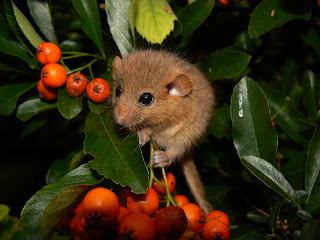
| Hazel Dormouse |
Until I started this series I had no idea how rich eastern
Europe and especially Ukraine is in rodents. Aside from this last group Ukraine
also holds Eurasian Beaver and Red Squirrel, both widespread species. As well
as those Ukraine is home to four different species of dormouse in the Gliridae and
nine different true mice in the Muridae. The two groups are not very closely
related and have quite different life strategies, with dormice often being very
long lived and with fairly low reproductive rates, while true mice are short
lived and are famously prolific.
Dormice are forest rather than grassland rodents, and as a
result in Ukraine their range is concentrated in the north and west of the
country, often in mountainous areas. They avoid steppe and agricultural fields,
though some species will use orchards and scrubland and even enter houses.
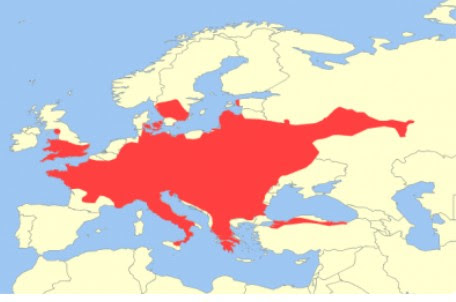 |
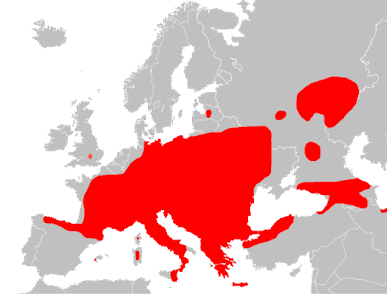
| Hazel Dormouse range |
With a range extending from Britain well into Russia, and
from Sweden south to Greece and northern Anatolia, the Hazel Dormouse as a
species is currently listed as Least Concern. In parts of its range however,
particularly in Britain, destruction of its habitat of deciduous woodland
especially Hazel scrub has seriously impacted local populations and it is seriously
endangered in Britain despite conservation efforts. Part of the problem is that
Hazel Dormice do best in dense scrub with a rich variety of different shrubs
and trees (they never feed on the ground but remain in the canopy) which
provide a continually changing supply of high energy food, and in the past the
practise of coppicing provided this easily. Coppicing is a means of ensuring a
continual supply of growths from the stump of a still living tree. On a 10-20
year cycle “poles” would be harvested from the “stools” of the coppiced trees,
which were usually hazel or sometimes willow, and used for agricultural fencing
or charcoal production. This resulted in continuously regenerating hazel scrub,
ideal for dormice. Today this has been abandoned except for conservation
management and the dormice have lost their habitat. Although they mostly stay
within 5m of the ground, they are quite squirrel-like in many ways and do not
hesitate to climb high into the canopy if there is food there.
Beginning in spring, on emerging from their famously lengthy
hibernation dormice first visit shrubs and vines such as Hawthorn and
Honeysuckle to gain energy from nectar and pollen. In summer they eat vast
amounts of insects, including aphids, and in the autumn they turn to berries
and nuts, including Yew berries. Especially in summer food can be scarce in bad
weather, and they handle this by going into torpor as they do in the winter.
This energy conserving strategy means reproduction is delayed, and in Britain
at least they only raise one litter of around four young a year, with perhaps
only one or two surviving to breed. To compensate they are long lived, with
survival over five years far from unknown. By comparison most wood mice and voles
live less than a year on average. Aside from habitat destruction climate change
is a potential threat. Ironically, warm winters, especially with variable temperatures,
are very damaging as they interrupt the animals’ hibernation strategy which
relies on near-freezing constant temperatures. Wet weather in summer also
interrupts the life cycle as dormice have trouble feeding in periods of
prolonged rain.
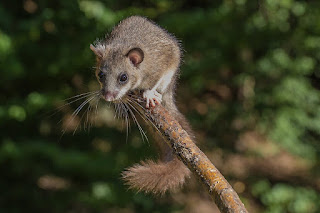 |
| Edible Dormouse |
While the mouse-sized Hazel Dormouse is a British native,
the squirrel-sized Edible Dormouse Glis glis was introduced to Britain in 1902
to an aristocrats’ estate in the Chiltern hills in southern England. The
species gets its English name from the ancient Roman fondness for eating them
as a delicacy. Apparently in Croatia and Slovenia this custom persists to this
day, and they are extensively trapped.
 |
| Edible Dormouse range |
Edible Dormice prefer mature forest rather than Hazel scrub,
and are particularly associated with Beech forest. Beech mast (seeds) are important
for successful breeding and in poor years the animals may not even come into
breeding condition – which is apparently triggered by the adults feeding on
beech flowers in the spring. As with their smaller cousins they are quite
omnivorous and shift their diet through the year. Before entering hibernation,
which can last seven months or more, they put on a lot of weight, giving their
alternative name of Fat Dormouse. Hibernation sites may be shared and where
available often include crevices in caves, and they can descend deep into them
in search of the right conditions. Failing that they can excavate their own
burrows in dry soil and are reported from studies on the British population to
seal themselves in entirely as protection against predators such as mustelids
As with other dormice they are long lived, over 12 years
having been recorded even in the wild. Associated with this they take some time
to reach maturity, probably not breeding until their third or fourth calendar
year. There are usually only 4 or five young in a litter, and usually only one
litter a year. They are quite territorial and are also quite vocal, with adults
calling from high branches to mark territory. Natural enemies would be
mustelids such as Beech and Pine martens and various raptors, especially owls.
 |
| Forest Dormouse |
Midway in size between the Hazel and Edible Dormouse, the
Forest Dormouse Dryomys nitedula is found away from agricultural areas in a
variety of forest types, including coniferous forest, and often at high
elevations. In Europe the densest population is in Moldova, but its range
extends eastward through Iran and Afghanistan into western China. As with other
dormice it is omnivorous and long lived. The specific name nitidula “nest
builder” refers to the large nests, similar to the drey of a squirrel, that they
construct from twigs to give birth in. Whether or not they hibernate, and for
how long, depends on the local climate, with individuals in Israel remaining
active year-round.
 |
| Forest Dormouse range |
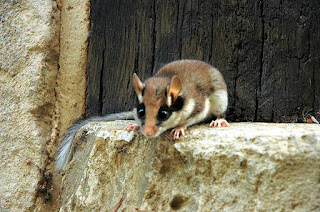 |
| Garden Dormouse |
Of a similar size to the Forest Dormouse, the Garden
Dormouse Eliomys quercinus is slightly more terrestrial than other dormice and is
often found in rocky areas. It is commonest in warmer climates around d the
Mediterranean, and several islands have endemic subspecies. It has declined
more than any other European rodent, especially in the east, and in Ukraine
there are only a few areas whgere it can be found. As a result it is classed as
Near Threatened by the IUCN, whereas other European dormice are all least
Concern. Although omnivorous like its relatives, its diet does seem to include
more animal protein than vegetable. It preys upon large insects, birds eggs and
nestlings, and even smaller rodents, but will also feed on various fruits and
nuts.
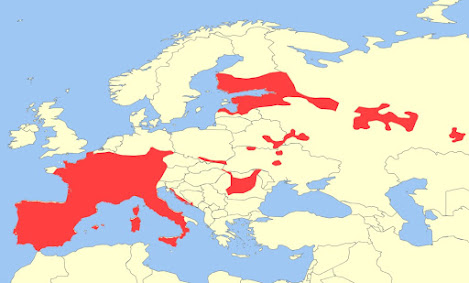 |
| Garden Dormouse range |
 |
| Northern Birch Mouse |
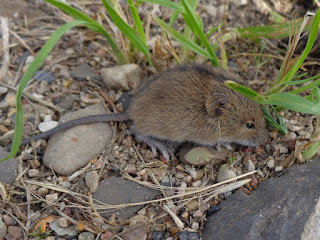
Most closely related to the jerboas, although of a far more
normal small rodent appearance, two species of birch mice are found in Ukraine.
Although closely related, the Northern Birch Mouse Sicista betulina and the Nordmanns
Birch Mouse Sicista loriger prefer different habitats and have different
ranges.
 |
| Northern Birch Mouse range |
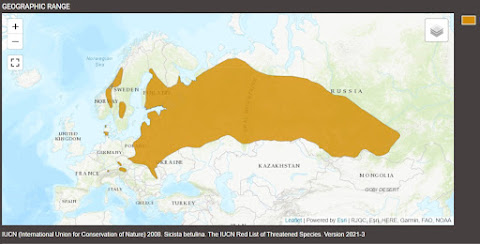
The Northern Birch Mouse has a range extending from
Scandinavia east to Lake Baikal, and south to the Carpathian mountains. As a
result it is on the southern edge of its range in Ukraine, where it lives in
coniferous or mixed deciduous woodland and wet scrub. It hibernates in the
winter for seven or eight months, and during the summer produces usually only a
single litter of up to six young. They feed mainly on various plant material
but also take insects, earthworms and snails. In the western part of its range
it is uncommon, but it is frequent in the east and as a result is classed as
Least Concern. Its only real threat would be deforestation and possibly climate
change.
 |
| Nordmanns Birch Mouse |
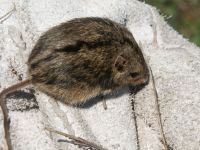
By contrast Nordmanns’ Birch Mouse is an animal of much more
open habitats, preferring steppe, open woodland, and even semi-desert. They do
not dig their own burrows but use natural holes or crevices. Like their
northern relatives they hibernate many months each year. Also unlike their relatives,
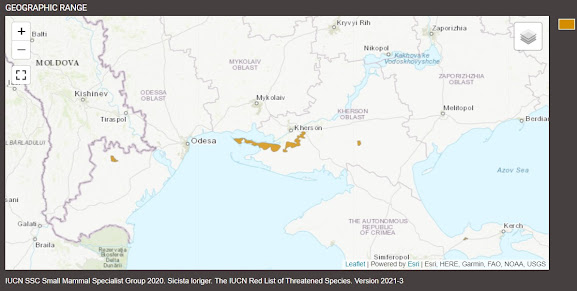
they have a very restricted range mostly in the grasslands east of Odessa with
a few isolated populations known in Moldova and Romania, plus one part of
southern Russia. As a result of this fragmented and probably declining
population they are listed as Vulnerable, and are at risk of agricultural
development and habitat destruction.
 |
| Nordmanns Birch Mouse range |
Dormice and Birch mice are both old groups of rodents, with
various Birch mice known from as long as 17 million years ago, and various dormice
from even longer ago. These ancient groups of rodents tend to have fairly low
reproductive rates and long lifespans, a life strategy adapted to relatively constant
and predictable habitats. During the Pleistocene the rapid climate fluctuations
has suited the evolution of species with high birth rates and short lives that
can rapidly take advantage of new conditions, and in Europe the various
Apodemus Wood Mice are classics of this type. Ukraine is home to five species, which
between them exploit habitats from grassland to closed canopy woodland,
although woodland edge with its wide variety of food usually hold the greatest
numbers. Apodemus species are mostly terrestrial, although they are agile and
will climb into bushes for berries and nuts as well as insects and other food.
They can have five litters a year of six or more young, so populations can
rapidly explode in good conditions.
 |
| Striped Field Mouse |
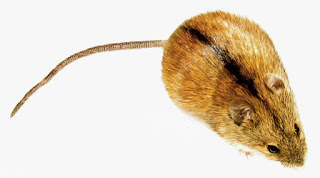
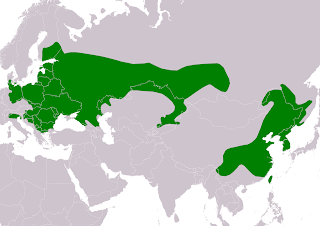
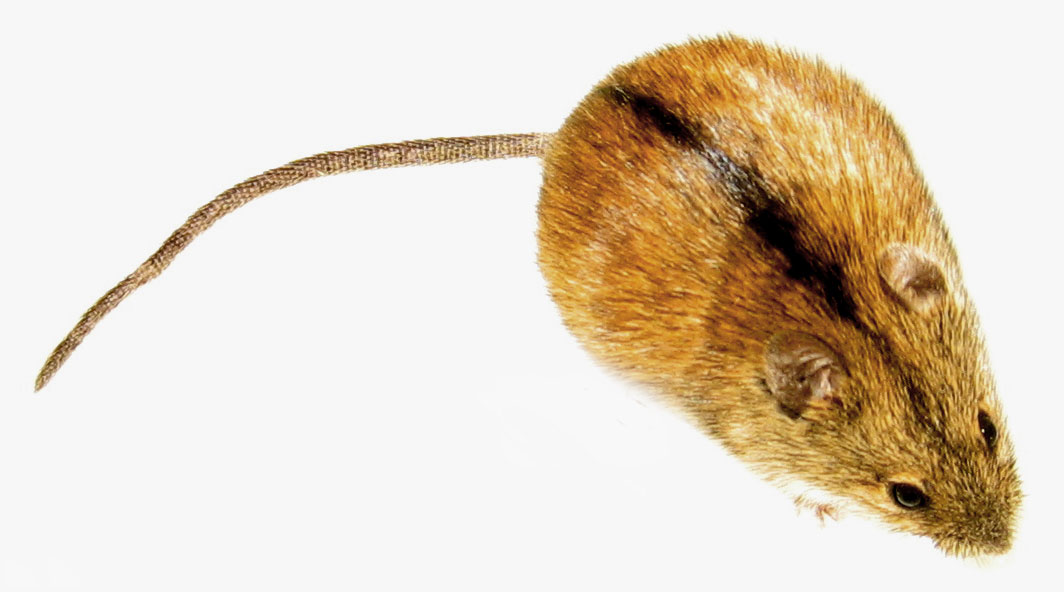
An example of this type is the Striped Field Mouse Apodemus agrarius,
which seems to be currently expanding its range westwards (it reached Austria
in the 1990’s) Fairly large for an Apodemus species, it can weigh 50g and 120mm
long. As well as being a serious agricultural pest on occasion they also harbour
a variety of dangerous viruses which are a risk to human and animal health. It
exists in two separate parts of the world, an eastern population in eastern
China and the second population centred in eastern Europe west to Italy and
Germany. The range expansion is most likely due to creation of farmland from
forest, which opened up new habitat.
 |
| Striped Field Mouse range |
 |
Yellow-Necked Mouse
|
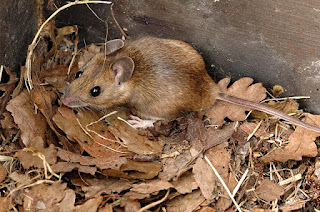
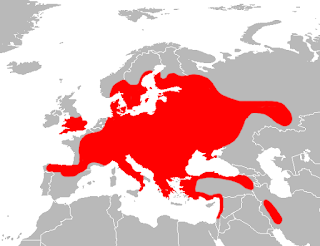
By contrast the Yellow-Necked Mouse Apodemus flavicollis is a
true European species. With arrange from southern Britain into Russia west of
the Ural Mountains. They prefer woodland or forest edge and are great hoarders
of acorns, hazel nuts and other large seeds. They dig extensive burrow systems
and will also climb into bushes or even enter houses.
 |
| Yellow-Necked Mouse range |
 |
| Eurasian Harvest Mouse |
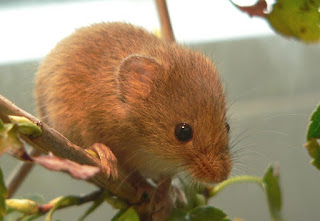
Given its truly gigantic range – it extends from Britain to
Vietnam – The Eurasian Harvest Mouse is listed by the IUCN as Least Concern.
Despite that, changes in farming practises have caused declines in many parts
of their range and in Britain they are a protected species. Their original
favoured habitat was probably tall grassland and reedbeds, which they still
favour today. They need permanent dense vegetation to make their winter nests
in and large agricultural fields are useless to them in the winter. In the spring
they climb up, helped by their prehensile tails, and make their nests suspended
in the grass or reeds in which they raise their large litters of young. They
are truly tiny animals, no bigger than 11g and usually half that.
 |
| Harvest Mouse range |
 |
| Steppe Mouse |
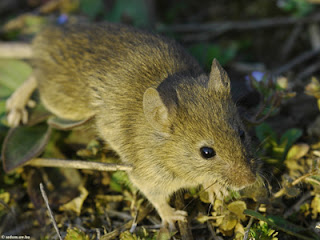
One final rodent to be found in Ukraine is the open-country
relative of the common House Mouse, the oddly-behaving Steppe or Mound-Building
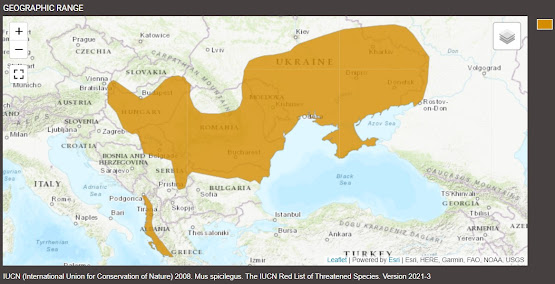
Mouse Mus spicilegus. They are classic steppe and open country animals, found
from Austria east into southern Ukraine and south into Greece. These animals
are hard to tell apart from House Mice until they are observed in the autumn.
At this time of year up to fourteen mice cooperate in gathering a mound to
protect their winter food stores.
 |
| Steppe Mouse mound |
These mounds are usually one or two metres
across, but mounds up to 4m across have been recorded, and when freshly built
can be 50cm high. Given the short life spans of these rodents the mounds are
actually built by the young of the year when they are only a few weeks old. The
storage chambers within the mounds can hold 10kg of food. Vegetation is also
incorporated into the structure of the mound, and it is possible that fermentation
of this generates heat to keep the nest builders warm. They are only social in
the winter – during the summer breeding season they become at least socially
monogamous with significant paternal care and females become quite aggressive
to rival females.
 |
| Steppe Mouse range |
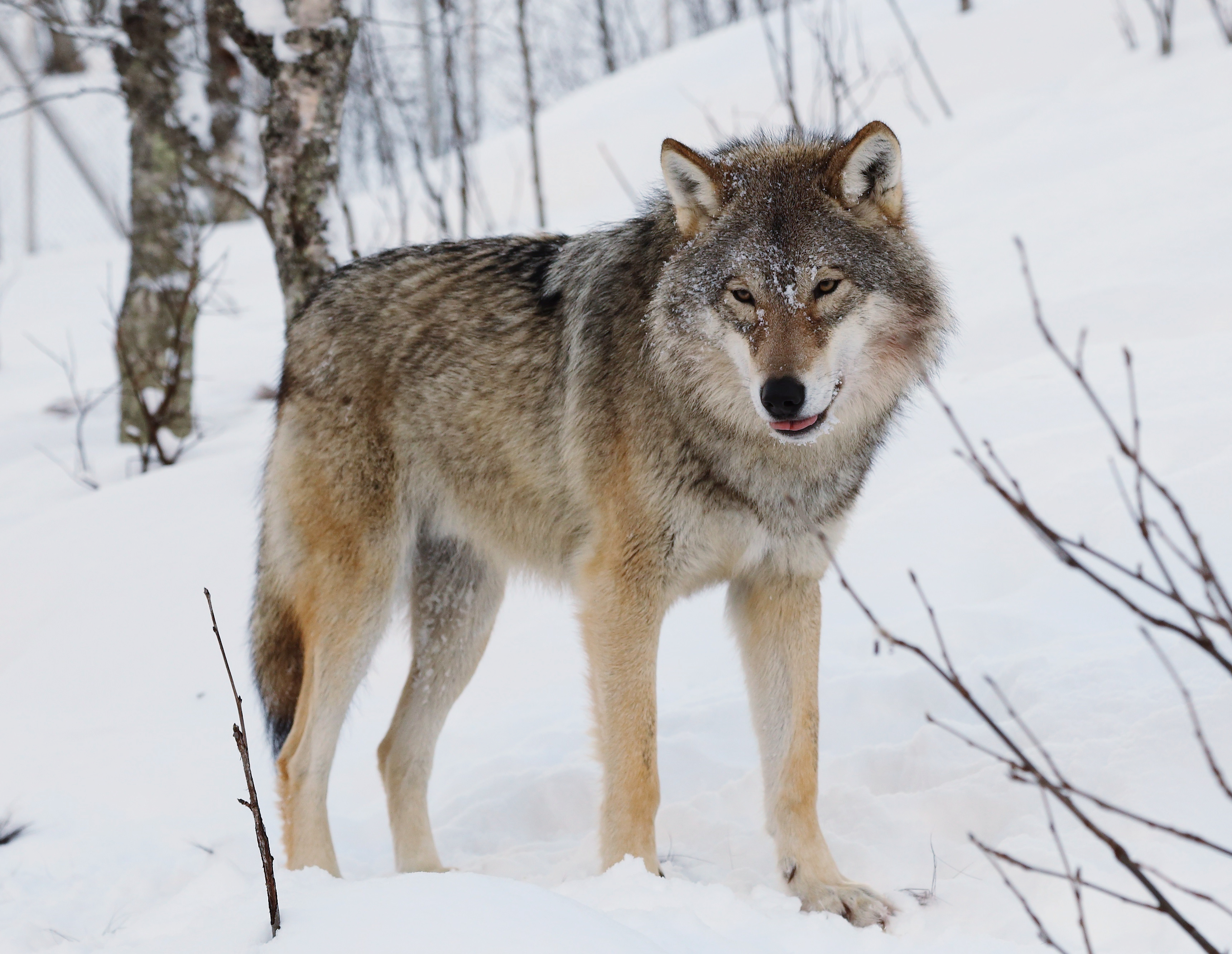
This concludes the survey of the rodents of Ukraine – next time
I will turn to the small carnivores that prey on them.


.jpg)

_Golden_jackal_2_(cropped).png)
.jpg)


.jpg)




.jpg)